The story so far
How Inner Atlas has changed shape.
Since 2025, Inner Atlas has been rebuilt more than once, always around the same question: does this help someone see themselves more clearly, or just look impressive?
This is a month-by-month record of what shipped, and why each change mattered. Newest first.
September 2026
A daily rhythm, a clearer view
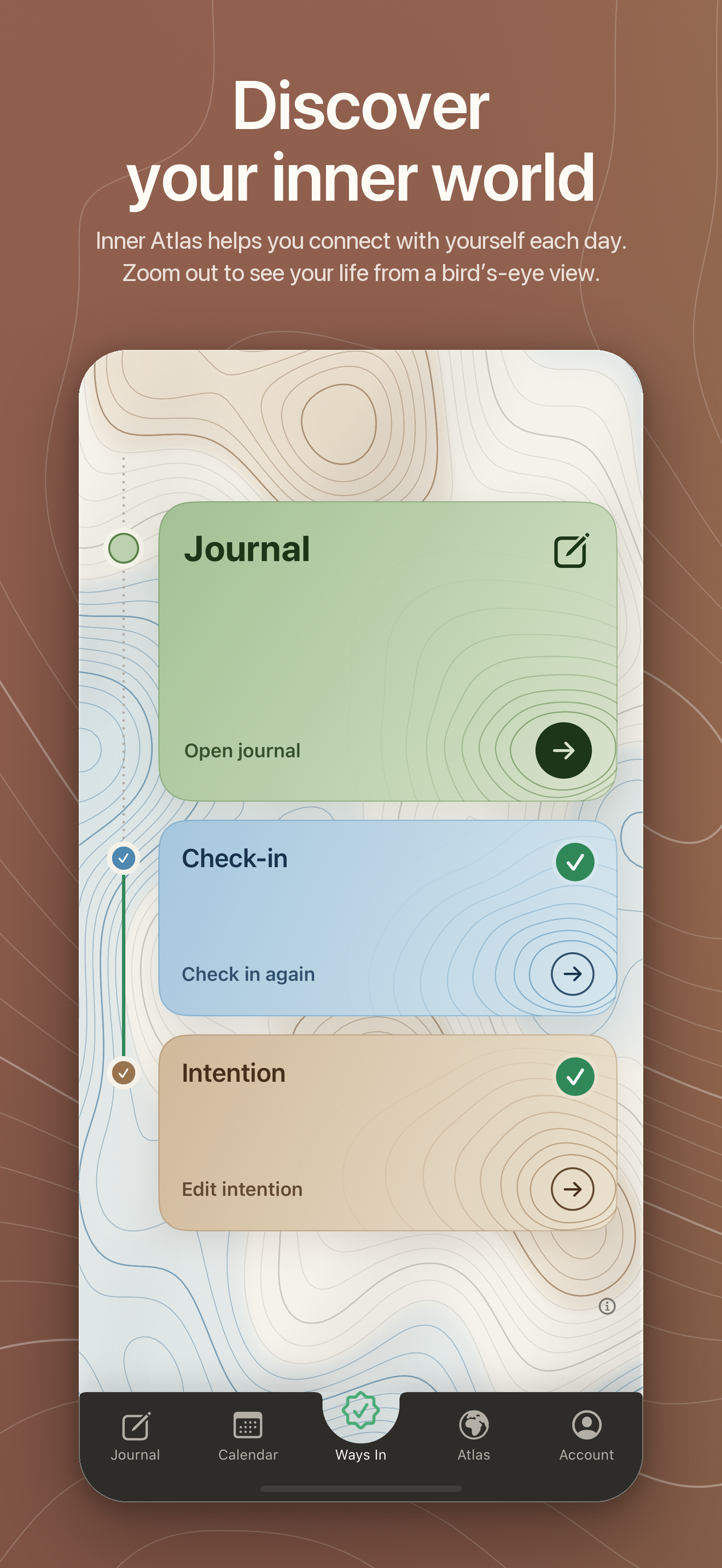
Ways In brings your journal, mood check-in, and daily intention together. The next unfinished card takes the lead, and ticks show what you have already done. In the evening, Intention becomes Gratitude, giving you a way to look back on the day. A new bottom navigation keeps Journal, Calendar, Ways In, Atlas, and Account within reach.
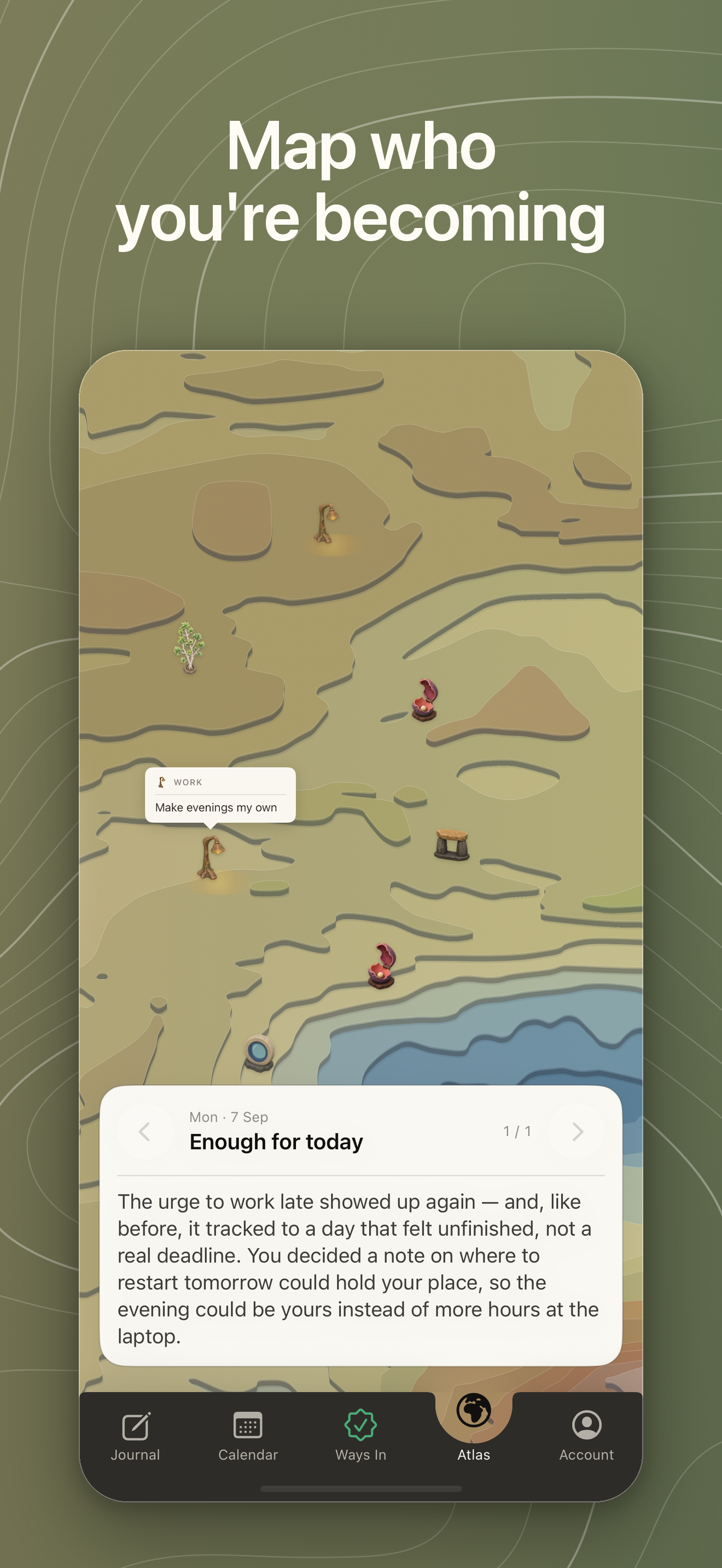
Atlas now connects Maps, Weather, and World. You can return to a journal session through its landmarks and summary, rise into your mood constellation, or look over the longer view of who you are becoming. Layered terrain gives the landmarks more depth and makes each discovery a place you can revisit.
Together, these changes connect the small act of checking in today with the bigger picture that grows over time.
August 2026
The whole thing, in your hand
Everything Inner Atlas had become came together as a real iPhone and iPad app you carry with you.
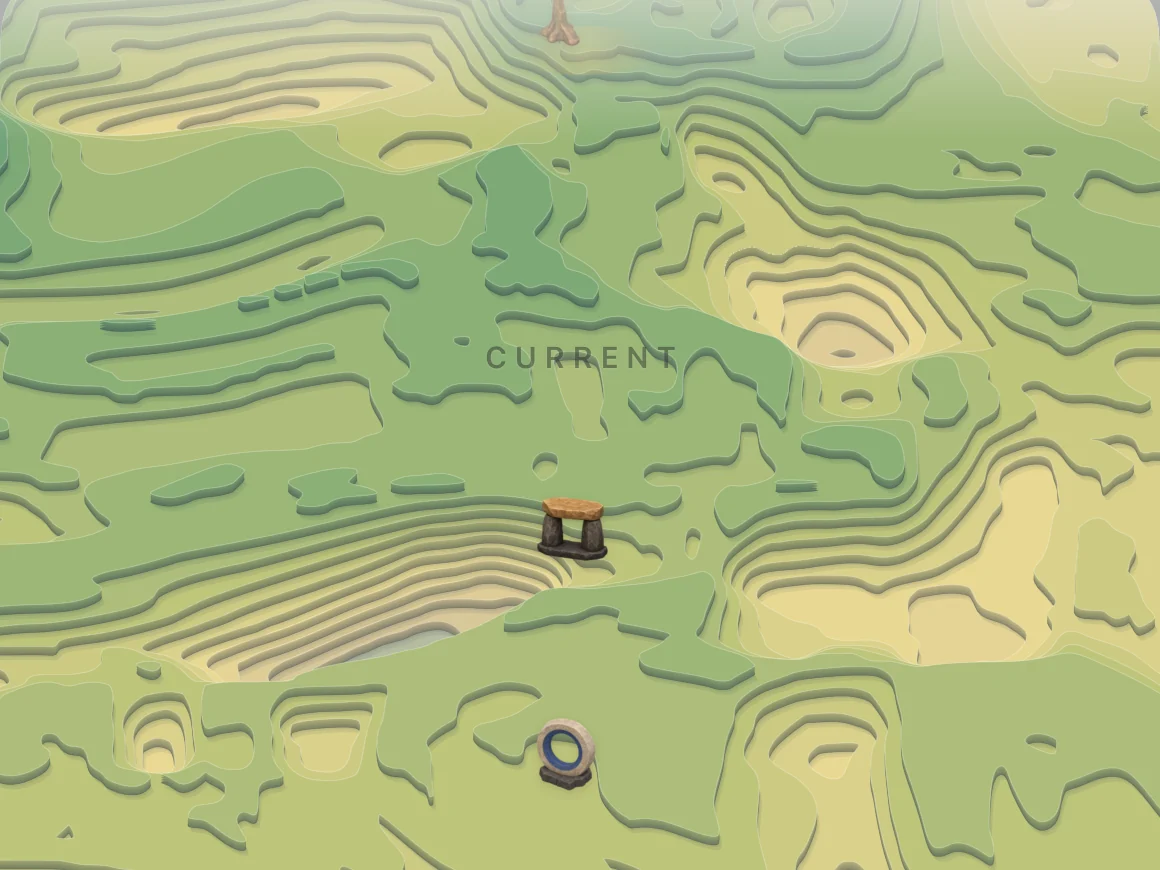
The surfaces built over the past year, the conversation, the map you page back through, the world of who you're becoming, the day planning and the felt-state weather, are now one native app running on iPhone and iPad. You can seed it with your older writing too, scanning paper pages or bringing across a memory from another assistant, so you never start from nothing.
Reflection is most useful in the moment it is needed: on the train, before a hard conversation, late at night, not only when you are sat at a desk. Putting the whole experience on the device you already carry is what turns Inner Atlas from a place you visit into something that is simply with you. It is the same product this record has been tracing, now where your life actually happens.
July 2026
Your feeling, reflected back, not scored
The hidden emotion metric became a felt state you can recognise, and a weather you can read.
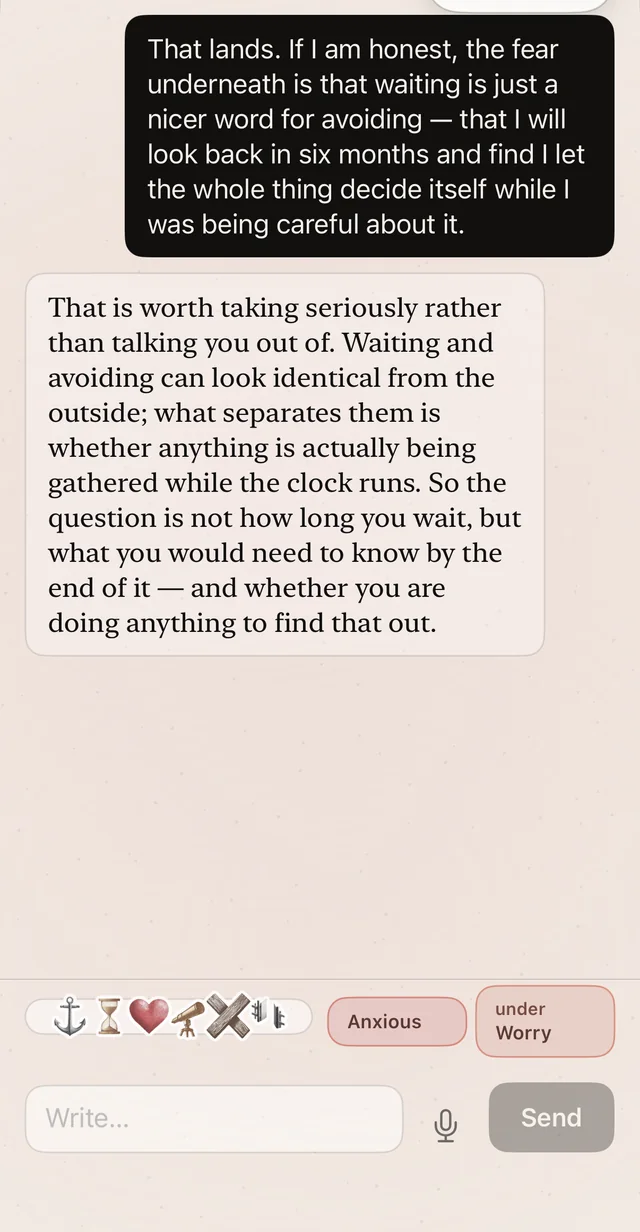
The reading that used to score your emotion in the background was replaced with a felt state: where you are right now, and the quieter undercurrent beneath it. Over a run of sessions these settle into a simple weather view of the season you are in.
The moment a feeling becomes a number it becomes something to optimise, and reflection turns into performance. Showing your state back as something you recognise, rather than grading it, keeps the emotional picture honest and free of diagnosis. It is the year's guiding idea applied to the most personal thing the product touches: show you to yourself, do not score you.
June 2026
Tools you use, instead of a world to decode
A small set of purposeful tools now appears beside your reply, and you can pin one to steer what comes next.
On the calmer surface, a few symbolic tools arrived, a pause, an anchor, a gate, a plan, appearing beside your reply only when they add something. Each does one real thing right where you are writing, and you can pin one to steer what comes next, or gather a run of thought into a short session summary when you are ready.
Where the old map asked you to interpret a world, the tools are the opposite, direct and optional invitations you actually use. Each is a small instrument for reflection rather than a symbol to learn. This was the month Inner Atlas chose being useful over being impressive, turning a place you looked at into a set of things you do.
May 2026
The islands gave way to something calm
The ornate islands and moving emotion flows were retired for a spare, minimal surface.
The elaborate islands and drifting emotion currents that had defined the map were retired. In their place came a spare surface, ink on a calm ground, with nothing moving that did not need to. The metaphor you once had to learn simply fell away.
The islands were beautiful, but they asked you to decode a world before it could help you, a layer of symbolism standing between you and yourself. Stripping the spectacle back was a deliberate choice of clarity over impressiveness, so nothing on the screen competes with the reflection. It cleared the ground for the tools that came next.
April 2026
A gentler way in past the blank page
A soft guided entry arrived for when you do not know where to start, and the welcome learned the time of day.
For the moments you open the app and do not know where to begin, a soft guided entry appeared, a few unpressured ways in, a mood, an intention, the body, the day ahead, in place of an empty composer. The opening also began reading the clock and how long you had been away, so a morning return is met differently from a late-night one.
The hardest moment in any reflection tool is the blank page. Offering a hand into the writing, attuned to your actual context, is often the difference between opening the app and quietly closing it again. It is a small thing that decides whether the rest ever gets a chance.
March 2026
A map you can read at a glance
Every idea took on its own symbol, drawn straight onto a single living terrain.
Each idea on your map began carrying its own mark for its kind, a value, a goal, a boundary, a habit, a trigger, set on the land itself instead of a field of identical dots. At the same time the many separate visuals resolved into one living terrain you return to, with its own atmosphere that shifts between visits.
A map you have to decode is a map you avoid. Giving each kind of idea a distinct symbol, placed on the terrain rather than buried in a label, lets you take in your inner landscape at a glance, the boundaries, the goals, the patterns you keep returning to. It is the difference between a diagram and a place.
February 2026
A map you can trust, every time
Your hypotheses settled into a real map of islands, drawn by an engine that checks its own work.
The parts of you that surfaced in reflection took shape as actual islands on a living map, and the engine that draws them was rebuilt to validate and repair its own work, retrying rather than ever handing back something malformed or half drawn. When a clean reading cannot be made, it keeps the last good map instead of showing you a broken one.
A reflection tool is only as trustworthy as what it shows you. If the map is sometimes garbled or half-missing, you stop believing it, and stop looking. Investing in the part you never see, so the picture is always coherent, is what later made it safe to strip the whole interface back. Less visible than any feature, and the reason everything after it holds together.
January 2026
Reflection that reaches your real week
A full calendar for what comes out of a session, and a way to pick up where you left off.
A proper calendar arrived for the intentions and commitments that surface while you reflect, tuned to appear instantly rather than stalling behind an error. Returning got easier too: you could pick up the thread of your last session instead of starting from nothing.
Insight that never leaves the app is just journaling. The calendar is the bridge from noticing something to deciding when you will act on it, and continuity between sessions is what turns scattered check-ins into something that builds. This is where reflection started reaching into ordinary life.
December 2025
Start freely, and stop being told who you are
Free trials with no signup arrived, and the fixed personality map was retired.
You could now reflect on a trial without creating an account, with a clear line between trying, subscribing, and being sponsored by someone else. The rigid personality map, which sorted you into set traits, was retired for understanding that forms from your own words. The first real phone layout landed here too.
Two barriers came down at once. The signup wall meant you could feel the value before committing anything. And being handed a fixed read of your personality is exactly the premature labelling Inner Atlas exists to avoid, so letting the picture emerge from what you actually say is both more honest and more useful.
November 2025
One screen became a place with rooms
Talking, seeing your patterns, and planning each got a space of their own.
The single view opened out into distinct surfaces: a place for the conversation, a place where recurring ideas gathered into a map, and a place for the plans that came out of them.
Reflecting, recognising a pattern, and acting on it are different kinds of work, and folding them into one screen served none of them well. Giving each its own room is what let Inner Atlas grow from a clever demo into somewhere you actually move around in. It was busier and more technical than today's four surfaces, but it set the shape everything since has refined.
October 2025
Reflection that adds up instead of resetting
Sessions began gathering into summaries, and feeling first showed up as colour.
Individual conversations started rolling into short session summaries you could return to, and your emotional tone appeared as a wash of colour across the map.
A single good conversation is easy to lose. This was the point the product started to remember, building a picture over time instead of starting cold each visit. Making feeling visible, however roughly, was the first ancestor of today's weather view.
September 2025
The bet: your inner life, made visible
Inner Atlas began as a map, not a chatbot, so reflection had somewhere to live.
The very first version turned what you shared into a map of landmarks, or islands, standing for parts of who you are, and it responded as you wrote.
Talking to an AI is easy to forget the moment you close the tab. Seeing your inner world laid out in front of you is different. The founding conviction was that reflection should gather into something you can look at and return to, not evaporate into a chat log. Everything since has been testing and refining that one idea.


Still being built, in the open.
This record grows as the product does. If you want to help shape where it goes next, the door is open.