For psychologists and counsellors
Somewhere for clients to keep the work between sessions.
Inner Atlas helps clients keep hold of what they work out between sessions, so they arrive at the next one with the thread intact.
It is a private journal app for iPhone. You see nothing. It does not diagnose, it does not flatter, and it never sells or trains AI on what clients write.
- What it is
- An iPhone app for reflective journaling. The client writes in an ongoing conversation, and the app slowly builds a picture of their values, patterns and pursuits.
- Who it serves
- Adults who want to understand themselves better, including clients in therapy who want somewhere to hold the work between sessions and over breaks.
- What you see
- Nothing. The client owns everything they write. They choose what to bring into the room.
- What it is not
- Therapy, a diagnostic tool, a crisis service or a companion. It makes no clinical claims and gives no diagnoses.
- Privacy
- Inner Atlas never sells data and never uses it to train AI models. Journal content is encrypted at rest under a key for each account. Clients can export everything or delete their account at any time.
What it helps a client do
Three things, every day.
Name what they feel
A precise word for the feeling, such as flat, tense or steady, instead of "fine".
Keep what they work out
What they realised on Tuesday comes back on Thursday, when it bears on what they are writing.
Decide what is true
The app proposes patterns over weeks. The client accepts, reshapes or rejects each one.
Why I built it
I have seen many psychologists over the last ten years, and the practice that stuck with me was journaling. But when I went back through my journals, I found the same lessons surfacing and fading every few months. I had written down my patterns again and again, and I still repeated them. Knowledge built up, but it did not turn into integration.
I built Inner Atlas to be that holding place. It remembers what a person works out and helps them find words for what they feel, without the sycophancy of existing AI tools. Throughout, I built on what psychology already knows about how people come to understand themselves.
How a session works
One loop: notice, write, reflect, decide.
Every screen here is the real app.
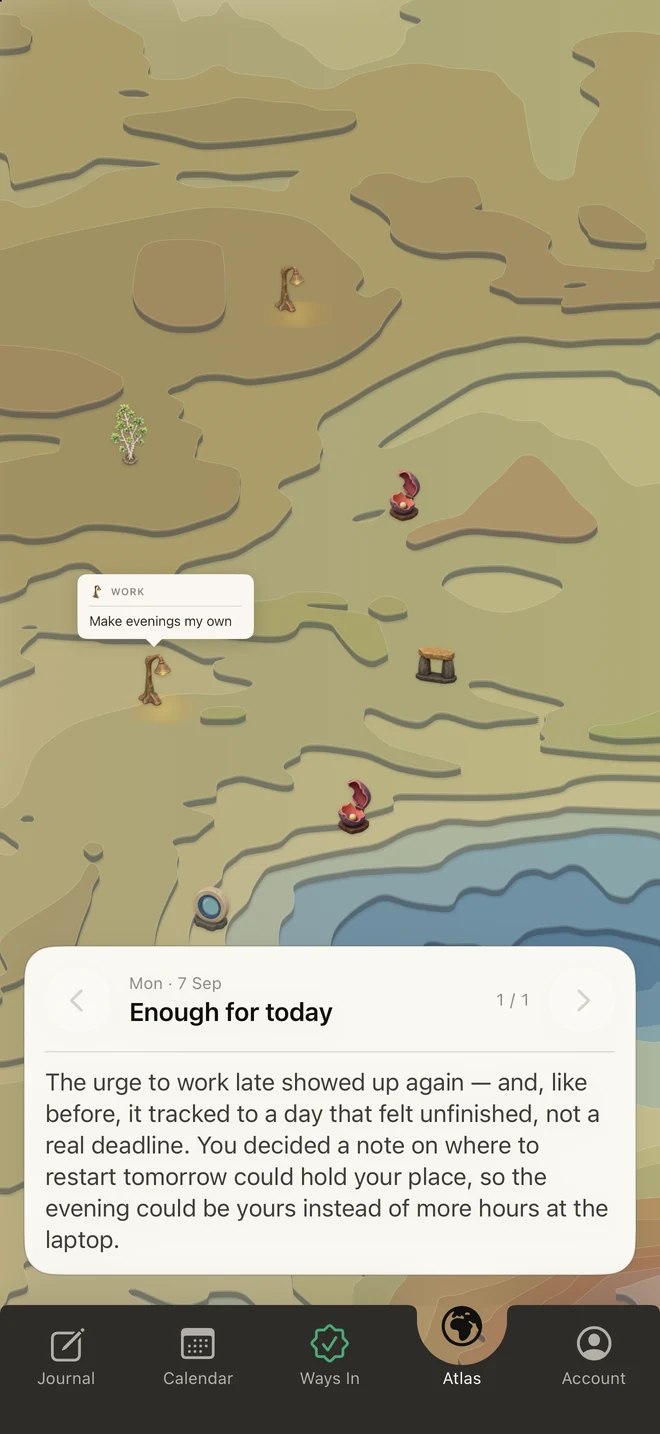
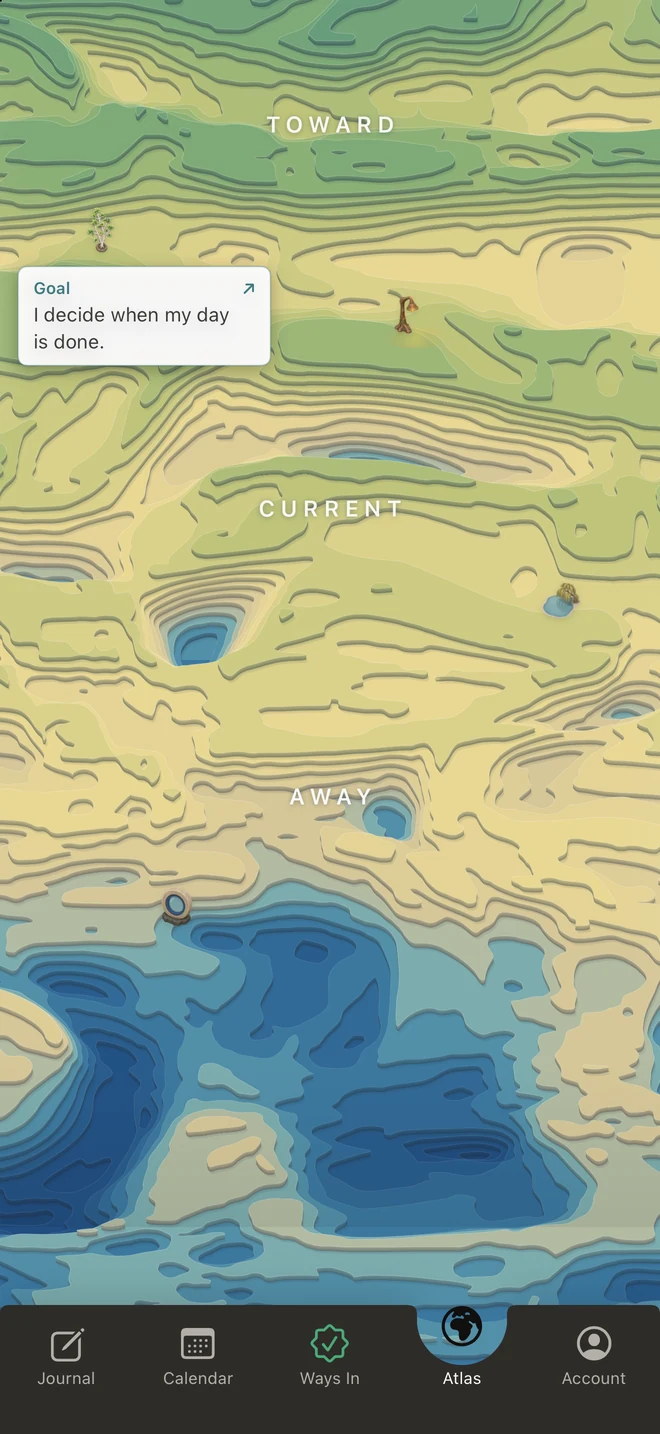
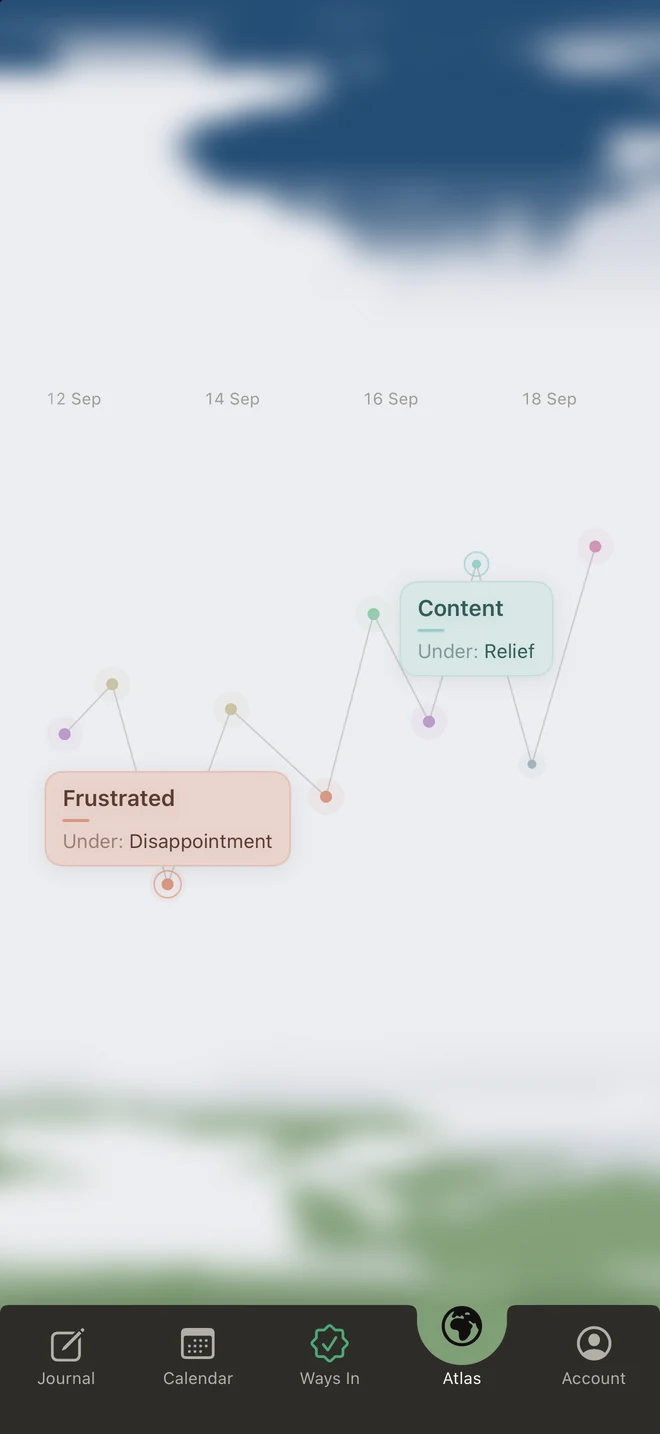
Check in
A precise word for the feeling.
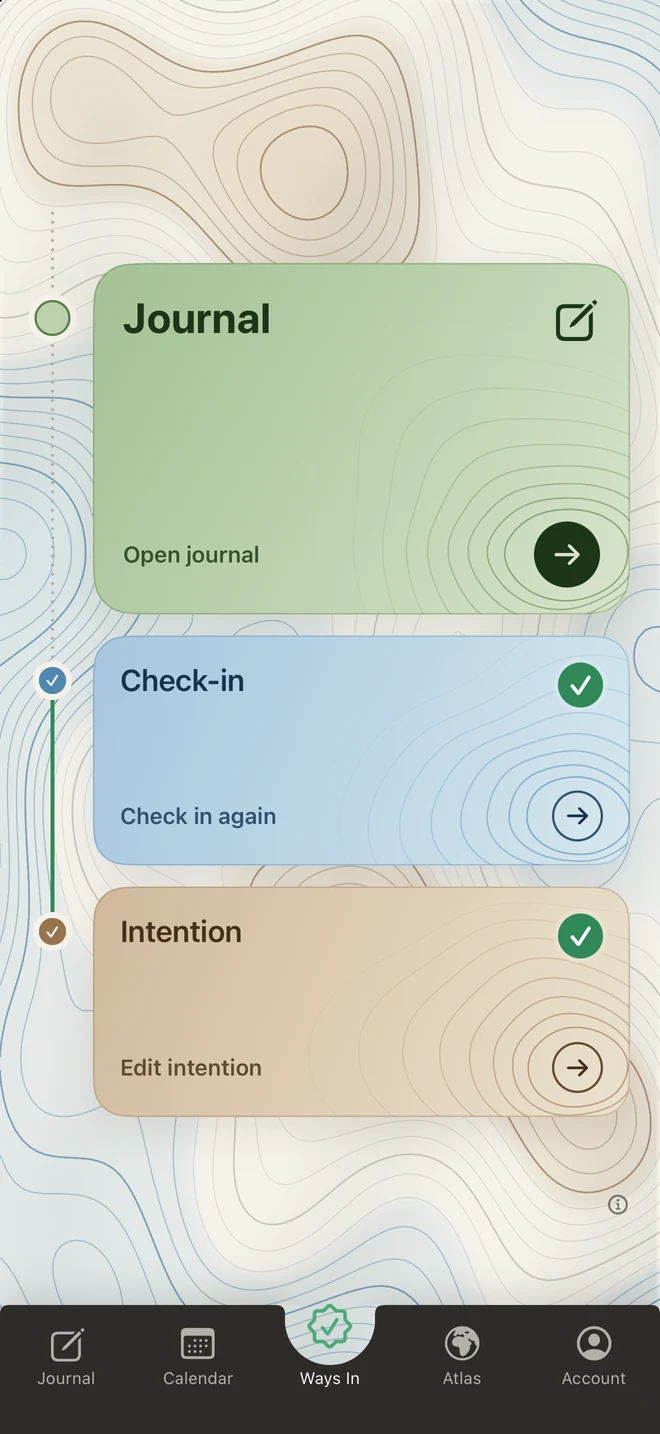
Each day opens on Ways In: the journal, a mood check-in and the day's intention.
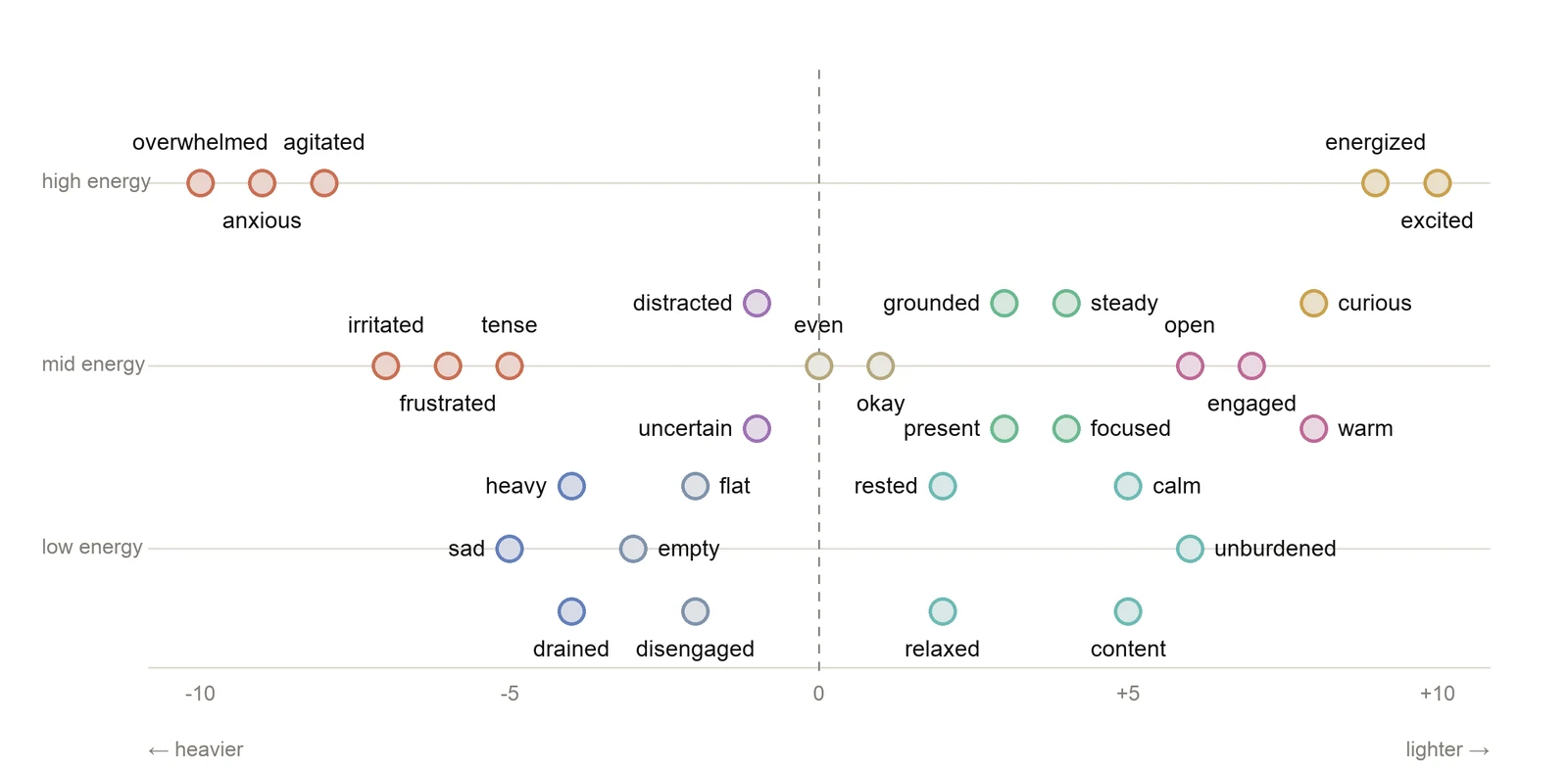
The check-in places the client's state on two axes, pleasantness and energy, to find the word for what they feel.
Write
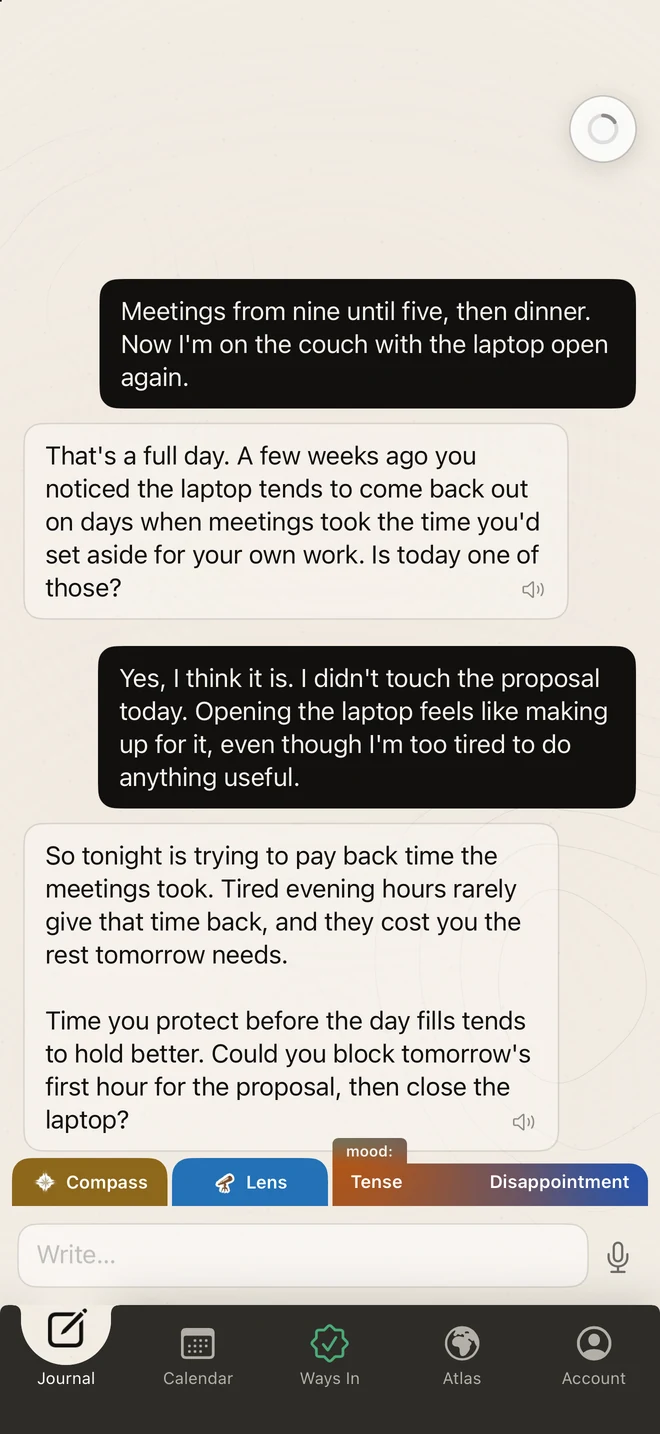
An ongoing conversation that pushes back.
The client journals in an ongoing conversation. The reply helps them make contact with what is present. It matches its depth to theirs and asks precise questions rather than guessing.
It pushes back when something is being overlooked. An anti-sycophancy memory system grounds it, and a separate crisis detection system watches over it.
Tool cards
One reflective move at a time.
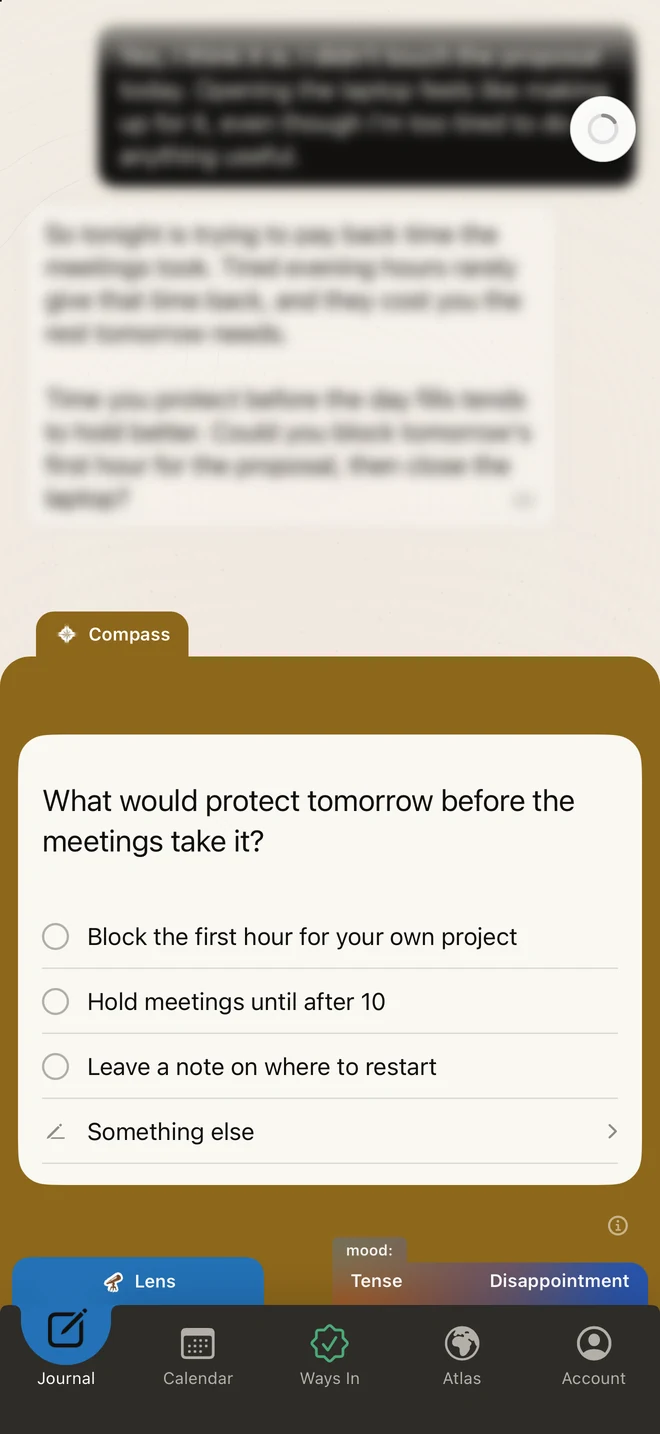
When a moment calls for it, a tool card offers one specific reflective move, such as separating a reading from a fact, choosing one next step, or grounding.
The client answers inside the card, with a tap or in their own words.
Emotional state
A reading the client can correct.
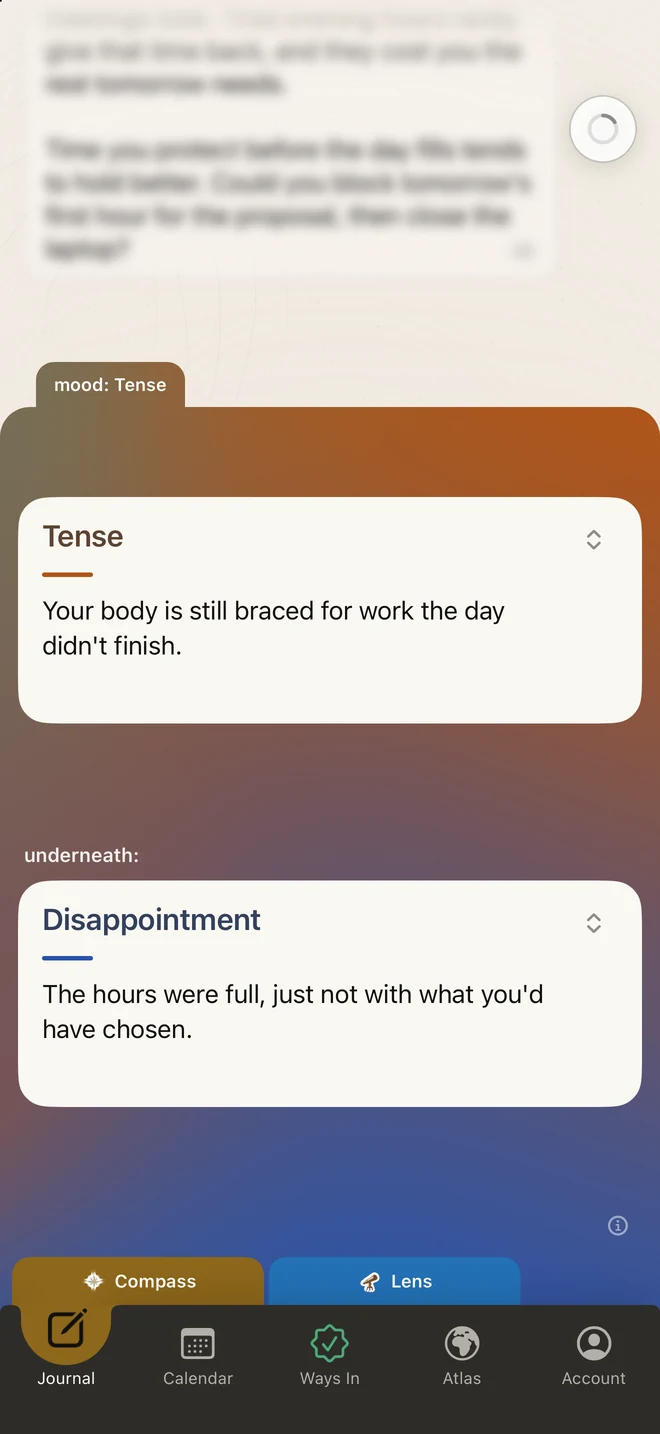
Each entry gets a reading of its main feeling and, when one is present, a feeling that may be running underneath.
The client can edit or correct either one. It is a reading to check, not a verdict.
Close the session
A hypothesis, not a conclusion.
A session ends by the twelfth exchange. The app summarises it and notes a tentative hypothesis about the person beneath the passing circumstance.
It also writes questions to bring into future conversations that would support or overturn that hypothesis. Maps replays each past session as a landscape.
Understanding
The client decides what is true.
Something mentioned once is never assumed to be always true. When a theme is stable, the app proposes it, and the client places it: moving toward, a current reality, moving away from, or simply false.
Only what the client places becomes part of their World. The app relies on the client's words, not its own interpretation.
Look back
How their moods move over time.
Weather shows how pleasant each day felt, how far it ranged, and which feelings ran underneath.
It calls no AI model. It graphs readings the client has seen and accepted.
Using it alongside therapy
The place where the week's material collects.
A client can check in when something happens, write it through while it is fresh, and arrive at the next session with the thread intact. What they bring into the room is their choice.
Most South African practices close from mid-December to mid-January, one of the most loaded stretches of the year. Over the break, Inner Atlas gives a client somewhere to keep doing the work and to notice what comes up, so that January starts where December left off.
“Somewhere to capture what comes up between sessions, so you can use it next time.”
Inner Atlas pays no referral fees or commissions to clinicians. A recommendation from you is a clinical judgement, never a commercial arrangement.
Safety
Inner Atlas signposts. It never treats.
With every entry, the model that reads the client's state may raise a private flag when a moment might need a safety check. A separate safety model, with its own instructions and context, then oversees the ongoing conversation. It distinguishes idiom, hyperbole and past events from present risk. When the evidence sits between two levels, it grades toward care.
- None
- The flag did not bear out. Nothing appears.
- Low
- Real weight, no risk. A quiet note offers support resources.
- Elevated
- Real but non-imminent risk. A support panel rises over the conversation.
- Acute
- Immediate danger. A care screen with emergency and crisis contacts replaces the conversation.
The model never writes a phone number, a service name or a link. A reviewed registry on the server supplies every resource, in a reviewed order that depends on the situation. For a disclosure of abuse, for example, the Gender-Based Violence Command Centre leads, ahead of the police. The South African set includes SADAG's suicide crisis line, the Cipla mental health line, the GBV Command Centre and emergency services. Calling or texting takes one tap at every stage, and no step ever stands between the client and help.
Returning to ordinary use from the acute screen asks for one short grounding exercise or two deliberate choices, so a person in crisis is never one reflexive tap away from dismissing it. Clients can keep a short list of trusted contacts, the people they would reach for, as a safety plan does. Safety-planning interventions were associated with a 43 percent reduction in suicidal behaviour in meta-analysis (Nuij et al., 2021).
The full set of support numbers is always available in Account settings, with no network connection needed. Inner Atlas connects people to real services and is not itself a crisis service.
Privacy and data
Built to clear the privacy bar most apps fail.
- Journal content is encrypted at rest under a separate key for each account, so a database breach on its own does not expose what clients wrote.
- AI providers process text only to produce a reply. Inner Atlas has signed zero-data-retention contracts with them, so client writing is never stored anywhere outside Inner Atlas.
- Inner Atlas never sells data, never shows advertising, and never uses client writing to train models.
- Each person's records are walled off at the database level.
- Clients can export all their data and writing, and can delete their account at any time. Deletion erases all data associated with that client.
- The service operates under South Africa's Protection of Personal Information Act, with a breach-notification plan in place.
What Inner Atlas will not do
Five refusals, built in.
It will not flatter
The reply pushes back when the client may be overlooking something, and it never invents facts about them. The memory and context system makes hallucination and sycophancy unlikely. Flattery feels good and erodes judgement (Cheng et al., 2026).
It will not pose as a person
Inner Atlas describes itself as a place that keeps and holds, never as a friend or companion that listens and cares. A client's relationships, including the one with you, stay with people.
It will not chase attention
The app has no streaks. It never sends a message because someone has been away, and it never rewards showing up. Rewards for engagement undermine intrinsic motivation (Deci, Koestner & Ryan, 1999). Notifications go out only for reminders the client set up.
It will not diagnose
Inner Atlas is a wellness product. It gives no clinical assessments, no diagnoses and no treatment. Its vocabulary describes regions of a self, such as values, ways, lenses and strengths, and avoids clinical categories.
It will not sell or train on what clients write
The business is a subscription. It has no advertising and no data brokerage.
The problem it is built around
Why a between-session tool, and why this one.
Clients forget most of what they work out
Insight from a session fades quickly. In one study of adults with bipolar disorder and insomnia, patients arrived at each weekly session recalling only 20 to 37 percent of the points their therapist had covered the week before. The patients who recalled more points improved more on sleep (Lee & Harvey, 2015). Harvey's group responded with a Memory Support Intervention: a set of strategies woven into treatment so that clients encode and keep what they learn (Harvey et al., 2014).
The work between sessions matters too. In meta-analyses of cognitive and behavioural therapies, homework improved outcomes (Kazantzis et al., 2010). The more homework clients completed, and the better they did it, the better their results (Kazantzis et al., 2016). Inner Atlas gives clients a place to do that work and keep it.
General chatbots fill the gap badly
Clients already talk to AI between sessions, and those tools carry known risks. Across eleven leading models, AI affirmed users' actions 49 percent more often than people did, including when the user described deception or harm. A single exchange with a flattering model made people less willing to repair a conflict, and people still preferred the flattering model (Cheng et al., 2026). Heavier emotional use of a general chatbot correlated with more loneliness and emotional dependence (Fang et al., 2025). General models also respond inconsistently to questions about suicide at moderate levels of risk (McBain et al., 2025). The American Psychological Association has advised that these tools are not a substitute for care (APA, 2025).
Wellness apps have a poor record with data
In Mozilla's 2023 review, 28 of 32 mental health apps earned its privacy warning label (Mozilla Foundation, 2023). In the United States, the FTC fined an online therapy platform $7.8 million for sharing health information with advertisers (FTC, 2023). Clinicians are right to be cautious. Inner Atlas is built on data the client owns, which is never sold or used to train AI, and it works only with AI providers bound by zero-data-retention contracts.
Care in South Africa is scarce, and it pauses
South Africa has about 2.5 psychologists for every 100,000 people. Most private practices also close from mid-December to mid-January. Inner Atlas is something a client can carry through that gap. It is never meant to replace therapy. It is a neutral, reflective tool for a client's self-understanding, awareness and compassion, designed to fit alongside existing practice.
The research behind each part
Every feature rests on something psychology already knows.
Naming feelings precisely
People differ in how finely they tell their feelings apart. Researchers call this emotional granularity, or emotion differentiation. Under intense distress, people with more granular emotions are less likely to binge drink, act aggressively or self-harm, and they show milder anxiety and depression (Kashdan, Barrett & McKnight, 2015). The skill can be taught. A brief intervention on emotion knowledge increased negative emotion differentiation, and the gain held a month later (Vedernikova et al., 2021).
Putting a feeling into words also regulates it. Labelling an emotional image reduced activity in the amygdala and increased activity in the right ventrolateral prefrontal cortex (Lieberman et al., 2007). Affect labelling works as implicit emotion regulation, even when it does not feel like regulation to the person doing it (Torre & Lieberman, 2018).
Inner Atlas builds this skill into every entry. Its mood field follows Russell's circumplex: pleasantness runs left to right and energy runs top to bottom (Russell, 1980). Yale's Mood Meter uses the same two dimensions (Brackett). The 31 states sit densest in the middle, so an ordinary day earns a precise word such as flat, distracted, steady or present, instead of collapsing to "fine". A second, optional reading names what runs underneath, from a set of 33 feelings such as longing, resentment, relief and pride. The goal is distinction rather than vocabulary. The client confirms each word, adjusts it to a neighbouring state, or rejects it.
Where it sits in the body
Emotions have consistent bodily signatures. When 701 participants coloured body silhouettes, each emotion produced a distinct map, and the maps agreed across Western European and East Asian samples (Nummenmaa et al., 2014). In the theory of constructed emotion, the brain builds feelings from interoceptive signals and learned concepts (Barrett, 2017).
The check-in's body map has six regions a client can point to: head, throat, chest, back, stomach and the whole body. The map is a way of noticing the body, not a list of symptoms.
Regulation comes before reflection
When an entry reads as acutely activated, the app offers grounding before any analysis. This card, called Anchor, opens above everything else. The model writes only one line naming what it noticed. The grounding exercises themselves are fixed, reviewed copy that no model can rewrite. An Anchor moment also brings in the separate safety model, which reads the current conversation to judge whether crisis support is needed.
| Exercise | What the client does | Basis |
|---|---|---|
| Breathe out | A led breath: four seconds in, six seconds out, for five rounds | Exhale-focused breathing improved mood more than mindfulness meditation in a month-long randomised trial (Balban et al., 2023). Slow breathing raises heart-rate variability and lowers arousal (Zaccaro et al., 2018). |
| Seated feeling | One hand on the chest and one on the belly, then slow taps | This self-soothing touch lowered cortisol after a standardised stressor (Dreisoerner et al., 2021). The crossed-arm taps come from the Butterfly Hug, a resourcing technique from EMDR practice (Artigas & Jarero). |
| Five senses | Count down: five things seen, four heard, and so on | A standard grounding skill in anxiety and trauma care that moves attention outward into the present. |
| Feel contact | Notice the ground and the chair holding the body | Interoceptive and proprioceptive grounding. |
| Seated stretches | Gentle chair yoga | Movement-based down-regulation. |
| Standing | Stand tall, shake out, press, breathe out | Discharges physical activation. |
| Visualise | Picture a calm place in detail | Safe-place imagery used in trauma-informed resourcing. |
After a grounding exercise, the next reply knows which technique the client completed. It asks what changed and meets them there.
Familiar clinical moves, offered one at a time
The cards borrow the shape of moves clinicians already use. The model offers at most a few cards per entry, and its rule is to prefer no card over a weak one. Each card does one thing. The client answers inside the card, and only cards the client acts on shape the next reply.
| Card | Appears when | Shares its shape with |
|---|---|---|
| Pause | A fast, hard-to-undo move is forming in the heat of the moment | DBT's STOP skill: space between the impulse and what is wanted |
| Lens | An interpretation is held as fact, or the frame has collapsed to catastrophe | Cognitive restructuring: the current reading beside a wider one |
| Cross | Two genuine wants pull against each other | Working with ambivalence: both sides named as valid, with no resolution forced |
| Gate | The client is over-extending or tolerating something unwanted | Boundary-setting and interpersonal effectiveness |
| Compass | The client is stuck and asking what to do first | Behavioural activation: one concrete step that can be done now |
| Heart | Something tender or self-critical is skipped or minimised | Noticing and naming with care |
| Ember | A good moment is reported and skimmed past | Savouring and capitalisation, which raise daily positive affect (Gable et al., 2004) |
| Lantern | What is said is ambiguous | A clarifying question in place of a guess |
| Knot | A pattern recurs and is visible in what was said | Tentative pattern-naming, grounded in evidence |
| Calendar | A specific date or time is named | Implementation intentions: a when and a where make follow-through more likely (Gollwitzer & Sheeran, 2006) |
| Clear | Nothing fits | The honest answer that the entry stands on its own |
Reading cards such as Heart and Pause offer three responses: go deeper, dismiss, or correct the reading in the client's own words. A wrong reading is easy to say no to.
Understanding that the client ratifies
Inner Atlas treats everything it infers as a hypothesis. This mirrors collaborative case conceptualisation, in which client and therapist build the formulation together, in the client's language, and test it against experience (Kuyken, Padesky & Dudley, 2009).
After each session, the app may note a tentative pattern. The pattern stays private to the app. It becomes a proposal only after a second review weighs it against the client's own words and finds the evidence holds. It becomes part of the client's atlas only when the client places it. Placement asks a question about direction: is this something I am moving toward, a current reality, or something I am moving away from? Possible-selves theory describes how such hoped-for and feared selves organise motivation (Markus & Nurius, 1986). The ACT Matrix uses the same toward and away language to separate moves toward values from moves away from discomfort (Polk & Schoendorff, 2014).
The app also guards against insight that only feels personal. People rate vague, flattering descriptions of themselves as highly accurate (Forer, 1949), and a language model can produce such descriptions without end. So every stage of Inner Atlas's reasoning has an honest empty answer. The app may decide that a session holds no lasting pattern, that an entry is simply even, or that its hypothesis was wrong. Anything the client marks false is retired, and the app learns from the correction.
Remembering what was worked out
The memory research above is the reason Inner Atlas exists. After each session, the app keeps a summary, any tentative patterns, the pursuits the client is actively living, and its own open questions about the client. In later conversations, the app brings in only what is relevant to the entry in front of it. A fresh conversation opens clean, and older material returns only when it clearly bears on the present. The aim is for the client to feel recognised, never watched.
For a client in therapy, this means the work done on a Tuesday night is still there on Thursday morning. In their own words, they can see what they noticed, what they decided, and what they are moving toward.
Seeing the shape of a week
Self-monitoring of mood is itself an intervention. In a randomised trial with young people with mild to moderate depression, an app for monitoring mood reduced depressive symptoms, and increased emotional self-awareness drove the change (Kauer et al., 2012). How feelings move matters as well as their average. A meta-analysis linked more variable and unstable emotions to poorer wellbeing (Houben, Van Den Noortgate & Kuppens, 2015).
Weather shows both. A line tracks how pleasant each day felt, a band shows each day's range, dot size shows energy, and a list counts the feelings that ran underneath. Weather calls no AI model. It plainly graphs emotional state readings the client has seen and accepted. Inner Atlas deliberately rejected a red-to-green scale, because difficult feelings are not failures. Accepting negative emotions without judging them predicts better psychological health (Ford et al., 2018).
Reflection that stays concrete
Self-focus can drift into rumination. Concrete processing of difficult events builds resilience, and abstract, evaluative processing feeds repetitive negative thought (Watkins, 2008). Reflecting from a distance supports insight and closure without reliving the event (Kross & Ayduk, 2011). Inner Atlas keeps reflection bounded and concrete in several ways:
- The reply matches depth to signal. A heavy topic mentioned lightly gets a light reply, with an option to go deeper.
- Cards use experience-first wording that describes the moment, never a label for the person.
- Conversations and context stay separated, which guards against an AI echo chamber, hallucination and sycophancy.
- A Cork card can offer to close a substantial exchange with one takeaway and what can be set down.
- The reply holds back closure when a topic deserves more than one exchange can give it.
The edges of the day
Mornings open with a one-line intention for the day. The client can then plan concrete items onto a calendar, carrying their pursuits and intentions into the day. In the evening, this flips to a gratitude practice: five things they were grateful for, and a short conversation that puts the day to rest without scoring it.
The client can also place a short check-in in front of an app they choose, which asks what they are reaching for before it opens. Instead of moving straight into scrolling, they can notice the feeling driving the urge and decide what they want to do. In a field study of a similar pause, social media openings fell by 57 percent over six weeks (Grüning, Riedel & Lorenz-Spreen, 2023).
Your view
Tell me where it falls short.
I would value your perspective, whether you try it yourself, suggest it to a client, or tell me where it misses the people you work with. Four questions help most:
- What do you think of the core concept, and how it has been carried out?
- What stands out as the wrong solution?
- What risks do you see?
- What would you need to see to recommend it to a client?
matthew@ryanmail.co.za
References
- American Psychological Association. (2025). Health advisory: Use of generative AI chatbots and wellness applications for mental health.
- Artigas, L., & Jarero, I. The Butterfly Hug. EMDR humanitarian protocol.
- Balban, M. Y., et al. (2023). Brief structured respiration practices enhance mood and reduce physiological arousal. Cell Reports Medicine, 4(1).
- Barrett, L. F. (2017). The theory of constructed emotion: An active inference account of interoception and categorization. Social Cognitive and Affective Neuroscience, 12(1), 1–23.
- Brackett, M. RULER and the Mood Meter. Yale Center for Emotional Intelligence.
- Cheng, M., Lee, C., Khadpe, P., Yu, S., Han, D., & Jurafsky, D. (2026). Sycophantic AI decreases prosocial intentions and promotes dependence. Science.
- Deci, E. L., Koestner, R., & Ryan, R. M. (1999). A meta-analytic review of experiments examining the effects of extrinsic rewards on intrinsic motivation. Psychological Bulletin, 125(6), 627–668.
- Dreisoerner, A., et al. (2021). Self-soothing touch and being hugged reduce cortisol responses to stress. Comprehensive Psychoneuroendocrinology, 8.
- Fang, C. M., et al. (2025). How AI and human behaviors shape psychosocial effects of chatbot use: A longitudinal randomized controlled study. MIT Media Lab and OpenAI.
- Ford, B. Q., Lam, P., John, O. P., & Mauss, I. B. (2018). The psychological health benefits of accepting negative emotions and thoughts. Journal of Personality and Social Psychology, 115(6), 1075–1092.
- Forer, B. R. (1949). The fallacy of personal validation. Journal of Abnormal and Social Psychology, 44(1), 118–123.
- US Federal Trade Commission. (2023). Final order banning BetterHelp from sharing sensitive health data for advertising.
- Gable, S. L., Reis, H. T., Impett, E. A., & Asher, E. R. (2004). What do you do when things go right? The intrapersonal and interpersonal benefits of sharing positive events. Journal of Personality and Social Psychology, 87(2), 228–245.
- Gollwitzer, P. M., & Sheeran, P. (2006). Implementation intentions and goal achievement: A meta-analysis of effects and processes. Advances in Experimental Social Psychology, 38, 69–119.
- Grüning, D. J., Riedel, F., & Lorenz-Spreen, P. (2023). Directing smartphone use through the self-nudge app one sec. Proceedings of the National Academy of Sciences, 120(8).
- Harvey, A. G., et al. (2014). Improving outcome of psychosocial treatments by enhancing memory and learning. Perspectives on Psychological Science, 9(2), 161–179.
- Houben, M., Van Den Noortgate, W., & Kuppens, P. (2015). The relation between short-term emotion dynamics and psychological well-being: A meta-analysis. Psychological Bulletin, 141(4), 901–930.
- Kashdan, T. B., Barrett, L. F., & McKnight, P. E. (2015). Unpacking emotion differentiation: Transforming unpleasant experience by perceiving distinctions in negativity. Current Directions in Psychological Science, 24(1), 10–16.
- Kauer, S. D., et al. (2012). Self-monitoring using mobile phones in the early stages of adolescent depression: Randomized controlled trial. Journal of Medical Internet Research, 14(3).
- Kazantzis, N., Whittington, C., & Dattilio, F. (2010). Meta-analysis of homework effects in cognitive and behavioral therapy: A replication and extension. Clinical Psychology: Science and Practice, 17(2), 144–156.
- Kazantzis, N., et al. (2016). Quantity and quality of homework compliance: A meta-analysis of relations with outcome in cognitive behavior therapy. Behavior Therapy, 47(5), 755–772.
- Kross, E., & Ayduk, O. (2011). Making meaning out of negative experiences by self-distancing. Current Directions in Psychological Science, 20(3), 187–191.
- Kuyken, W., Padesky, C. A., & Dudley, R. (2009). Collaborative case conceptualization: Working effectively with clients in cognitive-behavioral therapy. Guilford Press.
- Lee, J. Y., & Harvey, A. G. (2015). Memory for therapy in bipolar disorder and comorbid insomnia. Journal of Consulting and Clinical Psychology, 83(1), 92–102.
- Lieberman, M. D., et al. (2007). Putting feelings into words: Affect labeling disrupts amygdala activity in response to affective stimuli. Psychological Science, 18(5), 421–428.
- Markus, H., & Nurius, P. (1986). Possible selves. American Psychologist, 41(9), 954–969.
- McBain, R. K., et al. (2025). Evaluation of alignment between large language models and expert clinicians in suicide risk assessment. Psychiatric Services.
- Mozilla Foundation. (2023). Are mental health apps better or worse at privacy in 2023? Privacy Not Included.
- Nuij, C., et al. (2021). Safety planning-type interventions for suicide prevention: Meta-analysis. British Journal of Psychiatry, 219(2), 419–426.
- Nummenmaa, L., Glerean, E., Hari, R., & Hietanen, J. K. (2014). Bodily maps of emotions. Proceedings of the National Academy of Sciences, 111(2), 646–651.
- Polk, K. L., & Schoendorff, B. (Eds.). (2014). The ACT Matrix. New Harbinger.
- Russell, J. A. (1980). A circumplex model of affect. Journal of Personality and Social Psychology, 39(6), 1161–1178.
- Torre, J. B., & Lieberman, M. D. (2018). Putting feelings into words: Affect labeling as implicit emotion regulation. Emotion Review, 10(2), 116–124.
- Vedernikova, E., Kuppens, P., & Erbas, Y. (2021). From knowledge to differentiation: Increasing emotion knowledge through an intervention increases negative emotion differentiation. Frontiers in Psychology, 12.
- Watkins, E. R. (2008). Constructive and unconstructive repetitive thought. Psychological Bulletin, 134(2), 163–206.
- Zaccaro, A., et al. (2018). How breath-control can change your life: A systematic review on psycho-physiological correlates of slow breathing. Frontiers in Human Neuroscience, 12, 353.